
Verification Status: This article is an explanation based on publicly available information (no actual usage or transactions by the editorial team).
"Not enough payment again..." The reality of a president who can't sleep at night due to cash flow issues
On the last Friday of the month, only a few hundred thousand yen remains in hand. It will be over 40 days until payment from the client arrives──. Kenta Tanaka (39 years old, pseudonym), who runs a construction business, lets out a heavy sigh while staring at the bank balance displayed on his computer screen. Payments for material costs, salaries for three employees, and social insurance premiums—all are urgent payments that cannot be delayed. He has applied for bank working capital loans in the past, but was easily rejected due to the numbers in his financial statements. Moreover, loans that take weeks to get approval results are not suitable for his current crisis.
Tanaka is not alone. According to data from the Small and Medium Enterprise Agency, about 70% of domestic small and medium enterprises feel challenges with "cash flow." Particularly in industries like construction, medical care, and nursing care, payment terms from prime contractors and public institutions are long, creating a structural problem where working capital is prone to shortages. Even if efforts are made to secure work, funds do not circulate until the compensation is received, and as sales increase, cash becomes scarcer, constantly posing the risk of "profitable bankruptcy."
In desperation, Tanaka searched for the keyword "same-day factoring." What appeared on the screen was a factoring service from No.1 Co., Ltd., boasting "deposit in as little as 30 minutes" and "approval rate over 95%." "Is this too good to be true?" "Could it be a shady operator?" With a mix of hope and anxiety, he began gathering information late into the night.
In a nutshell: No.1 Co., Ltd.'s same-day factoring is a realistic means of converting "future money" in the form of accounts receivable into today's cash. If you correctly understand the fee structure and precautions, it can become a trump card to resolve urgent cash shortages.
In this article, from Tanaka's perspective, we will thoroughly verify No.1 Co., Ltd.'s factoring service based on publicly available information and multiple review sites.
Basics of Same-Day Factoring – What Does It Mean to "Sell Your Accounts Receivable"?

Image source: no1service.co.jp (Official Website) – Quoted for identification of the reviewed entity
For readers unfamiliar with the term "factoring," let's first clarify the mechanism. What Tanaka understood after researching all night was that this is not "borrowing" but "selling."
Factoring is a mechanism where a business sells its accounts receivable (trade receivables) to a factoring company before the payment due date to convert them into cash. For example, if a company holds ¥5 million in accounts receivable from a client, it can have No.1 Co., Ltd. purchase that claim and receive the amount minus fees on the same day. Unlike bank loans, this does not create new debt; it is merely a conversion of the company's own assets into cash, so liabilities on the balance sheet do not increase.
Additionally, factoring provided by No.1 Co., Ltd. is non-recourse as a principle. This means that even if the debtor goes bankrupt and becomes unable to pay, the user has no obligation to repurchase the claim. In other words, the factoring company assumes the credit risk of the debtor, allowing the user to confidently invest the received funds into their business. The fact that there is no "risk of being unable to repay borrowed money," which Tanaka feared most, can be said to be the greatest feature of factoring.
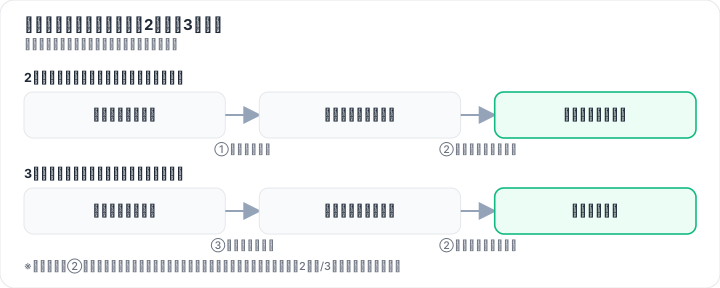
There are mainly two types of factoring methods:
- Two-Party Factoring: The contract is completed solely between the user and the factoring company. Since the debtor is not notified of the assignment of the claim, the user can raise funds without the client knowing. As a result, fee rates tend to be set higher.
- Three-Party Factoring: The contract involves the user, the debtor, and the factoring company. This requires the debtor's consent, making it more time-consuming, but it increases the certainty of collection for the factoring company, leading to lower fees.
No.1 Co., Ltd. supports both methods, and the flexibility to choose according to the situation is one of its features. According to information on the official website, it also supports online electronic contracts, allowing the entire process from application to payment to be completed from anywhere in Japan.
Tanaka's initial suspicion of "something fishy" gradually faded with this basic understanding. However, the next concern was, "How much will it actually cost?"
No.1 Co., Ltd.'s Fees Are Really 0.5%? The Mechanism Behind Two-Party and Three-Party Transactions
For business owners considering factoring, the biggest concern is undoubtedly the fees. Official websites often advertise "fees from 0.5% to 15%," but jumping to conclusions based solely on these figures and assuming it's "cheap" would be premature. By cross-referencing multiple comparison sites and user reviews, the actual situation becomes clearer.

The fee structure of No.1 Co., Ltd. differs significantly between two-party and three-party transactions.
- Three-Party Factoring: Fees are approximately 0.5% to 5%. The higher the creditworthiness of the accounts receivable debtor, the closer the fee tends to be to the lower limit. The minimum rate of "0.5%" emphasized on the official website is primarily achieved in large, high-quality three-party cases.
- Two-Party Factoring: Fees are approximately 5% to 15%. In exchange for the convenience of not notifying the business partner, the fee rate is set higher. Multiple review sites report that "the actual rate for two-party factoring is around 8% or more," so it is realistic to assume at least a few percent.
For example, if you factor ¥5 million in accounts receivable through three-party factoring at a 1% fee, you would receive ¥4.95 million. If you use the same receivable through two-party factoring at a 10% fee, you would receive ¥4.5 million. The difference amounts to ¥500,000. After seeing this estimate, Tanaka deepened his understanding, thinking, "Whether three-party factoring is available is the key to determining the fee burden."
Another point not to be overlooked is the 50% discount campaign on the first purchase fee. This measure, confirmed on the official website, significantly lowers the barrier for first-time users. By reducing the fee burden by half while experiencing the actual service quality and payment speed, Tanaka began to view it positively, thinking, "It seems worth trying first."
Note that fee rates vary depending on the timing and conditions of the case, so to find out the exact rate for your own accounts receivable, it is best to check via the official website free estimate.
Thorough Analysis of User Reviews – "The Representative's Understanding is Amazing" – Real Voices from Users
It's not just about the specs on paper; how actual users feel is also a concern. By examining reviews posted on multiple review sites, a certain trend emerged.
In the evaluations gathered on one review platform, many users shared positive feedback. Particularly notable were the ratings for "representative response" and "speed."
"It's not just about being 'fast'; their 'understanding' was outstanding—they immediately grasped the bottlenecks in our cash flow."
This is an encouraging statement for business owners struggling with cash flow. In bank loan screenings, it's common to be rejected based solely on past financial statement figures. However, this review reveals that the representatives at No.1 Co., Ltd. strive to understand the actual business conditions and cash flow behind the numbers.
There are also specific testimonials about the screening process.
"During the screening, they focused on checking the 'contract structure with our accounts receivable' and 'whether there were any past payment delays.'"
This shows that rather than judging solely by the surface-level figures in financial statements, a practical screening is conducted based on the creditworthiness of the accounts receivable and the actual transaction status. This likely supports the high "screening pass rate of over 95%."
On the other hand, negative points also honestly exist.
"The 1% fee rate applies only to three-party transactions; in reality, the rate for two-party transactions is 8%."
As this comment indicates, if you take the "0.5%~" figure at face value, you might be surprised by unexpected fees at the estimate stage. Additionally, multiple sites confirmed complaints about the inability to handle requests on weekends and holidays. For industries where urgent funding needs arise on weekends, this is indeed a concerning limitation.
Overall, while the reviews include realistic complaints about fees and business day restrictions, the majority of voices express satisfaction with "quality of service" and "deposit speed." Seeing this balance, Mr. Tanaka felt that "rather than just superficial good reviews, the presence of realistic evaluations actually makes it more trustworthy."
Simulating the Process from Application to Funding – Does It Really Arrive in as Little as 30 Minutes?
"As little as 30 minutes" – drawn in by this figure, Mr. Tanaka looked into the actual usage steps in detail. Based on information from the official website and multiple comparison sites, the process from application to funding consists of the following six steps.
- Application: Contact via phone or the official website form. Available 24 hours, you first communicate your desired conditions.
- Interview and Screening: A representative calls you back to confirm the creditworthiness of the accounts receivable counterparty, transaction details, and your preferred factoring method. At this stage, the track record of a screening pass rate of 95% or higher comes into play.
- Submission of Required Documents: Submit financial statements (up to two fiscal years), invoices confirming accounts receivable, and a copy of your bankbook. Document submission is completed via email or online upload.
- Final Confirmation: Conduct a final confirmation of the contract terms and fees through an in-person or online meeting. Even if you are far away, this can be handled online.
- Contract: Formally sign a two-party or three-party contract. Electronic contracts are supported, so no mailing is required.
- Funding: After the contract is signed, funds are transferred to your designated account in as little as 30 minutes. This speed is said to be easily achievable during weekday business hours.
The required documents are mainly three items: "financial statements," "invoices," and "a copy of your bankbook." All are documents you would typically have on hand from your daily accounting work. Mr. Tanaka was relieved, thinking, "I can prepare these by today."
However, there are conditions for the "as little as 30 minutes" claim. Naturally, it takes longer during peak application periods at the end of the month, if there are deficiencies in the documents, or if weekends or holidays are involved. Nevertheless, unlike bank loans that require waiting for weeks, in most cases, funds are deposited on the same day or within a few business days.
After organizing the information so far, Mr. Tanaka thought: "A free estimate carries zero risk. First, let me find out how much it would be under my conditions, just by talking to them." The free estimate is completed online, and obtaining an estimate does not obligate you to sign a contract. Even just gathering information is valuable for expanding your options for future cash flow management.
[Comparison Table] QuQuMo, Paytorner, and Bank Loans – What’s the Difference?
When considering factoring, it’s important to understand how it differs from other options. In addition to No.1 Co., Ltd., Tanaka tried comparing factoring companies that promise same-day service and traditional bank loans. Based on information from multiple comparison sites, the table below summarizes the three main options.
| Item | No.1 Co., Ltd. | QuQuMo | Paytorner | Bank Loans (General Example) |
|---|---|---|---|---|
| Fee Rate (Lower to Upper Limit) | 0.5% to 15% | — | — | Interest rate approx. 1% to 3% |
| Shortest Funding Time | Shortest 30 minutes | Shortest same day | Shortest same day | Several weeks to over 1 month |
| Minimum Purchase Amount | From ¥200,000 | Small amounts accepted | Small amounts accepted | From several million yen |
| Weekend/Holiday Support | Not available | Available | Available | Generally not available |
| Online Completion | Yes | — | — | Face-to-face is standard |
| Eligible Businesses | Corporations and sole proprietors | Mainly sole proprietors | Mainly sole proprietors | Mainly corporations (strict screening for sole proprietors) |
| Debt Recording | None | None | None | Yes |
| Risk of Client Bankruptcy | None (non-recourse) | — | — | Borne by user (obligation to repay) |
What emerges from this table is the difference in each service’s area of expertise. QuQuMo and Paytorner leverage small amounts and weekend support as strengths, enabling quick responses to small-scale funding needs. On the other hand, No.1 Co., Ltd. sets a minimum purchase amount of ¥200,000, making it suitable for businesses looking to cash in large accounts receivable at low fees. Additionally, offering menus specialized for the construction industry and medical/nursing care fees sets it apart from general same-day factoring companies.
Bank loans may look attractive in terms of interest rates alone, but they come with drawbacks such as long screening periods, a screening approach that emphasizes financial statements, and increased debt from borrowing. In situations where "funds are urgently needed right now," factoring often wins out in terms of speed and flexibility. After comparison, Tanaka also concluded that "as a stopgap measure, factoring is more realistic."
Three Points to Note and Countermeasures Before Applying
Every service has its drawbacks. Knowing them in advance can prevent the mismatch of "it wasn't what I expected." Based on public information and reviews that Tanaka researched, here are three key points to be particularly aware of.

① No service on weekends and holidays. The golden rule is to act by Friday. Kabushiki Kaisha No.1's business days are weekdays only. Even if an urgent funding need arises over the weekend, same-day service is not available. The countermeasure is simple: as soon as you feel funds might run short, complete your application by Friday. If you act with a margin before month-end payments are due, this limitation is manageable.
② Fees for two-party factoring are high. Consider three-party factoring or take advantage of the first-time discount. Fees for two-party factoring range from 5% to 15%, which can feel heavy as a funding cost depending on the situation. The primary countermeasure is to choose three-party factoring if you can obtain consent from your accounts receivable partner. While notification may be difficult depending on your relationship with the client, using the first-time 50% fee discount campaign can reduce the burden for the initial use even with two-party factoring. Using it "as a trial to get a feel for the fees" is also a realistic approach.
③ Two fiscal years of financial statements are required. This can be a hurdle for new businesses. In principle, Kabushiki Kaisha No.1 requires submission of up to two fiscal years of financial statements for screening. Therefore, this can be a hurdle for newly established businesses or freelancers who have not yet completed a single fiscal year. However, this is not a rigid rule that "two years are absolutely required or you're out." It's worth consulting with them first. In actual screening, there is a tendency to emphasize the creditworthiness of the accounts receivable partner and the actual transaction history, so there is room to check if individual arrangements can be made even when documents are incomplete.
These points of caution, when viewed from the opposite side, mean that "countermeasures exist." Knowing them in advance means they don't have to be a reason to rule out this funding option. Tanaka kept these in the back of his mind but judged that "these don't seem like fatal disadvantages for me."
In Conclusion, Who Kabushiki-gaisha No.1 Is Really For—A Clear Statement on Suitability
Having gathered all this information, Mr. Tanaka is now in the final stages of determining whether this service is right for him. The conclusions drawn from public information and user reviews are as follows.
Those who are a good fit for Kabushiki-gaisha No.1
- Corporations and sole proprietors needing immediate, lump-sum funds: With a minimum purchase amount of ¥200,000, it enables much faster cash conversion than bank loans.
- Those who prioritize high approval rates: An approval rate of over 95% provides significant reassurance for businesses that have previously been denied loans.
- Businesses in the construction, medical, and nursing care industries: Specialized menus are available for these sectors, and you can expect support that understands industry-specific business practices and payment terms.
- First-time factoring users: By taking advantage of the 50% discount on the initial fee, you can experience the actual service while minimizing cost risk.
Those who are not a good fit for Kabushiki-gaisha No.1
- Those who need to raise small amounts under ¥200,000 on the same day: Since the minimum purchase amount is ¥200,000, services specializing in small amounts like QuQuMo or Paytner are more suitable for small-scale funding needs.
- Those who absolutely need to process transactions on weekends or holidays: As the service operates only on weekdays, if weekend support is essential, it is more reliable to consider other same-day factoring companies.
- Newly established businesses that cannot prepare financial statements at all: Since financial statements are required as a prerequisite for screening, it may be difficult to pass the screening process if you have just started your business.
In Mr. Tanaka's case, he is in the construction industry with accounts receivable in the millions of yen, has previously been denied bank loans, and his need for funds is urgent—"right now." In other words, this is a typical example where Kabushiki-gaisha No.1's strengths are most effective. The reason he ultimately made up his mind and said, "This is it," was precisely because of this personal assessment. Moreover, since you can try the initial discount as a free estimate or demo, you can take the first step without taking on financial risk.
Why President Tanaka Took That First Step—Zero Risk, Start Today with a Free Estimate
"If I don't move, nothing will change." After finishing his late-night research, Kenta Tanaka muttered this to himself and closed his laptop. What ultimately led him to decide to apply was the "free estimate" system, which served as a perfect risk reversal.
A free estimate is a simple step: just fill in the necessary details online and submit. Requesting an estimate does not obligate you to a contract in any way. You can find out what fees apply to your accounts receivable and how much cash you can get. Once you see the numbers, you can take your time to think it over. The track record of a 95% or higher approval rate also makes the risk of wasting time feel lower.
His hesitation, rooted in the suspicion that "this might be shady," had already been dispelled by objective facts such as the public disclosure of the National Tax Agency's corporate number, a track record of transactions with MUFG Bank, and the acquisition of the DX Mark certification. All that remained was to confirm "how much I can get under my conditions."
The longer you leave cash flow issues unattended, the fewer options you have. On the other hand, taking action with a free estimate carries no financial burden or obligation; it simply offers the value of "gaining information." Even if you decide not to use the service this time, the information you obtain will surely be useful for your next cash flow decision. This is why Tanaka felt he could "start today with zero risk."
On the official website, you can check the latest terms, including a 50% discount campaign on the initial fee. Why not start, like him, by sharing your situation and learning the specific numbers?
※ Notes Fee rates, screening criteria, and the fastest deposit times vary depending on the content and timing of the application. The information in this article is based on publicly available data as of July 2026. Factoring involves the sale of accounts receivable, not a lending business, and is one method of fundraising. It differs from illegal lenders or so-called "salary factoring." Please always confirm the final contract terms on the official website and in the contract documents.
Methodology and Disclosure
Verification Method: This article is based on publicly available information confirmed as of 2026-07-16. The editorial team has not actually contracted or used the services in question. This is an explanation based on publicly available information (official websites, third-party reviews, user testimonials). As service details, fees, and campaigns are subject to change, please be sure to check the official information before applying.
Operator Information: The editorial policy and evaluation criteria for this article are described in the Editorial Policy, and the verification procedures are described in the Evaluation Method. If there are any errors in the content, please report them to the contact window.
Affiliate Disclosure: This article contains affiliate links, and our site may receive compensation without additional cost to the reader. The compensation does not affect the evaluation content.
Frequently Asked Questions
Is factoring not a loan?
Yes, it is not a loan but a sale of accounts receivable. It does not increase liabilities, and there is no obligation to repay. Since it is non-recourse, you are not required to buy back the receivables even if the debtor goes bankrupt.
Are fees really from 0.5%?
Yes, for high-quality three-party factoring cases, fees start from 0.5% (conditions apply). For two-party factoring, the actual rate is around 5% to 15%. There is also a first-time 50% discount campaign.
Can I fail the screening?
Yes, you can. Screening is based on the creditworthiness of the debtor and the nature of the receivables. However, the pass rate is high at over 95%, and even companies with a deficit can use it if the receivables are reliable.
Can I apply on weekends or holidays?
Yes, you can apply online 24 hours a day. Electronic contracts are supported, and in some cases, funds can be deposited in as little as 30 minutes.
What documents are required?
You will need identification documents such as a driver's license, contracts and invoices with the debtor, and recent financial statements. Details can be confirmed via the free quote on the official website.
Can I use it even if my company has a deficit?
Yes, you can. Factoring is based on the value of the receivables, and a deficit in financial statements does not directly affect the screening. The creditworthiness of the debtor is what matters.
When is the earliest I can receive the funds?
Funds can be deposited in as little as 30 minutes. After applying online, the screening is conducted quickly, and if conditions are met, the funds are deposited on the same day.
References / Sources
This article is based on publicly available information as of 2026-07-16.
- Invoice (Accounts Receivable) High-Value Same-Day Purchase – Factoring Service for Funding in as Little as 30 Minutes | No.1 Co., Ltd.
- Factoring for Sole Proprietors – High-Value Same-Day Invoice (Accounts Receivable) Purchase | No.1 Co., Ltd.
- Flow from Contract to Factoring Service | No.1 Co., Ltd.
- 【2025 Latest】Factoring for Beginners! Complete Guide to Factoring | No.1 Co., Ltd.
- No.1 Co., Ltd. Factoring Reputation? Thorough Investigation of Reviews, Fees, and Screening 【2026 Latest】 – FundBridge
- Is No.1 Co., Ltd. Factoring Worth Using? Explanation of Construction/Medical/Nursing Specialization and 5% Fee Reality | Japan Funding Support Center
- No.1 Co., Ltd. Factoring Reviews and Reputation|Screening and Fees 【2026】
- No.1 Factoring Reviews and Reputation|Thorough Explanation of Fees, Screening, and Required Documents 【2026 Latest】 | Facutto
- No.1 Co., Ltd. Factoring Reviews and Reputation? Thorough Verification of Fees and Over 90% Screening Pass Rate 【2026 Latest】 | Cash Flow Navi
- Thorough Explanation of No.1 Co., Ltd. Factoring|Fees, Features, Application Procedure 【2026 Edition】 – Cash Flow Research Institute
- No.1 Co., Ltd. Factoring Reputation and Reviews|Thorough Verification of User Feedback | Factoring Magazine
- Easy Factor (No.1 Co., Ltd.) Factoring Thorough Review|Fees, Reputation, Application Procedure 【2026 Edition】 – Cash Flow Research Institute
Related articles
Active Support (Invoice Factoring) Review 2026: Fees, Ratings & User Feedback
Active Support's QuQuMo is an online invoice factoring service that offers funding in as fast as 2 hours. Fees start from 1% (conditions apply) with low minimum amounts. Non-recourse factoring protects against your client's bankruptcy. Ideal for 2026 cash flow management.
Why Ad Planning (ADP) Factoring Is Chosen in July 2026: 2% Fee, Fastest 30-Minute Screening, and Reviews
Latest in 2026. Ad Planning's factoring offers fastest 30-minute screening and same-day funding, with fees starting at 2% (conditions apply). Even companies with deficit settlements or tax arrears can consult. Handles a wide range from 100,000 yen to 100 million yen for corporations. Also introduces reviews and comparisons with other companies.
[2026 Latest] What is the reputation of QuQuMo online accounts receivable advance payment? Who can use it based on fees and reviews?
A thorough explanation of the latest reviews and feedback on QuQuMo online accounts receivable advance payment in 2026. Introduces the reality of fees ranging from 1.0% to 14.8% (conditions apply), the conditions for the fastest 2-hour deposit, and whether sole proprietors can use it.