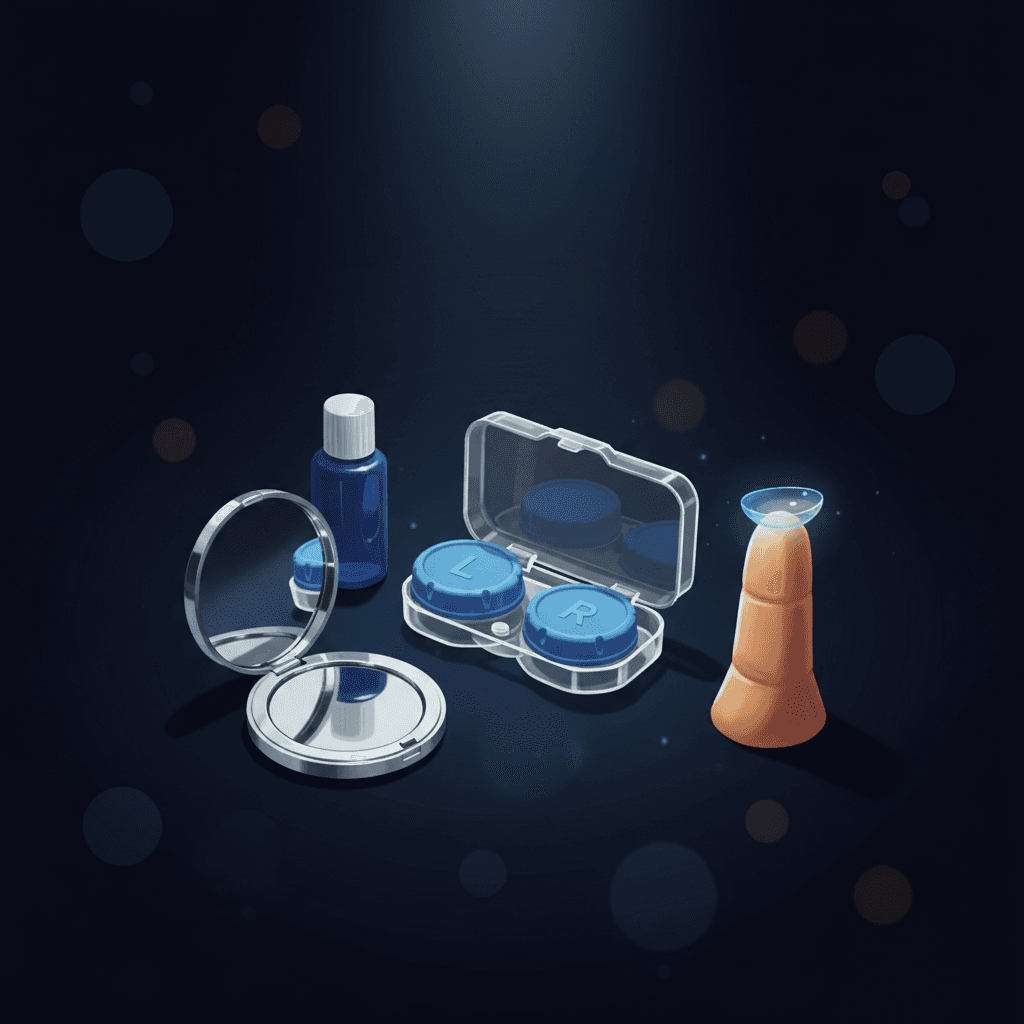
Conclusion When choosing your first daily disposable contact lenses, the key factor is frequency of use. For occasional wear (once a week to a few times a month), opt for affordable clear lenses in 30-pack boxes (starting around ¥1,250). If you plan to wear them almost every weekday, consider options with UV protection or silicone hydrogel materials (approximately ¥2,500–¥6,500 per month). For travel or special events, small trial packs combined with portable care supplies are the most practical choice. In all cases, an eye examination and prescription from an ophthalmologist are mandatory; starting with a single box for your first purchase is the smartest way to avoid unnecessary spending.
Identify Your Beginner Type
The "essential kit" for one-day contacts varies depending on how often and why you use them. Clarifying your usage habits first helps narrow down what you should buy.
Type 1: Occasional Users (Once a Week to a Few Times a Month)
These are people who only wear lenses for sports or going out. Since they don't use them daily, priority is placed on having clean, fresh lenses available when needed rather than minimizing cost. Even a single box of 30 lenses can last approximately 7 to 8 months if used just once a week.
Type 2: Frequent Users (Almost Every Weekday)
This group is making a full switch from glasses to contact lenses. When using lenses in both eyes, consumption reaches approximately 730 lenses per year. Therefore, balancing the cost per lens with wearing comfort becomes crucial.
Type 3: Event & Travel Preparers
These individuals primarily wear glasses but want to keep a supply on hand for special occasions like weddings or trips. Since usage is infrequent, small packaging sizes and portability become the key selection criteria.
Type 4: Foreign Residents in Japan Concerned About Local Purchases
This refers to individuals anxious about visiting ophthalmologists or using online stores in Japanese. In Japan, contact lenses are classified as highly controlled medical devices, requiring an eye exam and prescription from an ophthalmologist before purchase. The first steps involve finding an English-speaking ophthalmologist and verifying whether online stores offer multilingual support and compatible payment methods.
Estimated Costs
Real-world data from Rakuten shows that a 30-lens box of daily disposable contact lenses sells for approximately ¥1,250 to ¥3,256. Budget-friendly options include "Pure Aqua One-Day Clear UV Moist" (30 lenses) at around ¥1,250, with two-box sets available for about ¥2,290 (roughly ¥1,145 per box). On the higher end, "Purity 1day," which features blue-light filtering, costs approximately ¥3,256 for 30 lenses.
If used daily in both eyes, you will consume roughly 730 lenses per year. Since one 30-lens box lasts 30 days for one eye (or 15 days for both eyes), daily wear requires two boxes per month. This translates to an estimated monthly cost of around ¥2,500 for budget brands and approximately ¥6,500 for premium models with added features.
Initial expenses include the "eye examination fee plus the cost of lenses." Eye exam fees are typically not covered by insurance and vary by clinic, but generally range from several thousand yen to around ¥10,000. For lens costs, use the price ranges mentioned above as a guideline.
Recommended Categories by User Type
| User Type | Recommended Category | Estimated Budget | Reason |
|---|---|---|---|
| Occasional users (1x/week to a few times/month) | Low-cost Daily Clear Contact Lenses (30-pack) | Approx. ¥1,250 per box | Ideal for low-frequency users; affordable small packs allow for easy trial. Hygienic single-use design minimizes waste. |
| Daily weekday users | Daily Contact Lenses with UV Protection | Approx. ¥1,250–¥3,256 per box | Suitable for frequent long-hour wear; prioritizes features like UV protection and moisture retention. |
| Daily weekday users (concerned about dryness) | Silicone Hydrogel Daily Contact Lenses | Approx. ¥2,500 per box | Often selected for their superior balance of oxygen permeability and moisture, according to official specifications. |
| Heavy computer users | Daily Contact Lenses with Blue Light Filter | Approx. ¥3,256 per box | Designed for extended screen time. While priced higher, they are a viable option for frequent users. |
| Users with astigmatism | Toric Daily Contact Lenses | Approx. ¥2,000–¥4,000 per box | Astigmatism correction requires a prescription from an ophthalmologist; always consult a specialist before purchasing. |
Prices are estimated ranges based on actual data from Rakuten. Prices for toric lenses are estimates based on the typical price range for standard 30-pack daily lenses.
How to Choose
Start by Trying One Box
Comfort and visual clarity with contact lenses vary from person to person. Even with the same lens, some users find them "perfectly comfortable" while others feel a "foreign body sensation." Therefore, the key to avoiding wasteful spending is to avoid bulk buying initially and instead try just one box first.
Narrow Down to Three Options First
For first-time buyers, selection becomes much easier if you focus on just three types: "Low-Cost Clear," "UV Protection," and "Blue Light Blocking." Having too many choices often leads to decision paralysis, resulting in selections made on a mere "hunch." Start by choosing from these three based on your frequency of use and budget.
Balance Usage Frequency and Cost
If you only wear lenses once a week, choosing high-functionality, high-priced models results in a disproportionate cost per use. Conversely, if you wear them daily for long hours but choose based solely on low price, you may end up dissatisfied with the comfort level. It is most rational to determine the balance between your usage frequency and budget beforehand.
Common Mistakes and How to Avoid Them
Mistake 1: Buying Online Without an Eye Prescription
In Japan, contact lenses are classified as highly controlled medical devices. Official information from Acuvue explicitly states that "an examination and prescription by an ophthalmologist are mandatory." Purchasing without a prescription carries the risk of using lenses unsuitable for your eyes. Always undergo an eye exam first to confirm your prescription strength, check for astigmatism, and verify lens compatibility before making a purchase.
Mistake 2: Bulk Buying (e.g., 6-Box Sets) Immediately
Even if you think buying in bulk is cheaper, purchasing large quantities is wasteful if the lenses do not suit your eyes. While marketplaces like Rakuten offer 6-box sets for approximately ¥6,850, it is safer to start with a single box (30 lenses) for your first order. Once you have confirmed comfort and fit, you can proceed with repeat orders or bulk purchases.
Mistake 3: Not Choosing Toric Lenses Despite Having Astigmatism
If you have astigmatism, standard clear lenses may provide insufficient vision correction. Have an ophthalmologist measure your astigmatism power and prescribe toric lenses if necessary. Choosing standard lenses based on self-assessment often leads to dissatisfaction due to blurred or unclear vision.
Mistake 4: Buying Full Care Kits for Daily Disposables
Daily disposable lenses are designed for single-day use, so care solutions for rubbing, disinfecting, or protein removal are generally unnecessary. First-time buyers often feel compelled to buy a complete care kit, but all you really need are the lenses themselves (based on your prescription) and a small portable case for carrying spares.
For Example: How to Get Started (Hypothetical Scenarios)
Example 1: An Office Worker Starting for Weekly Futsal (Hypothetical Scenario)
This person usually wears glasses but wants to switch to contact lenses just for a weekly futsal game. In this case, the first step is to visit an ophthalmologist to check the prescription and determine if astigmatism is present. Purchase one box of affordable clear daily disposables (30 lenses, approx. ¥1,250~) that match the prescription. With once-a-week usage, a single box will last about seven months, offering excellent cost performance. There is no need to buy care solutions; simply keep a spare lens or two in a portable case inside a bag. If they don't fit well, only one box of a different type needs to be tried, making this a low-waste way to begin.
Example 2: For a Partner Who Stares at Screens All Day (Hypothetical Scenario)
A partner who works at a computer in the office every weekday wants to switch from glasses to daily disposable contact lenses. In this scenario, it is reasonable to first try one box of daily disposables with blue light filtering (30 lenses, approx. ¥3,256~) after obtaining an ophthalmologist's prescription. Choose features suited for a lifestyle involving long hours of screen time, and after confirming comfort, consider purchasing 2-box or 6-box sets. Since they will be used daily, budgeting approximately ¥6,500 per month provides peace of mind. Even if giving them as a gift, it is essential that the recipient visits an ophthalmologist first to confirm their prescription.
Example 3: When a Foreign Friend Living in Japan Wants Them for Travel (Hypothetical Scenario)
A foreign friend living in Japan says, "I only want to use them while traveling." In Japan, contact lenses are classified as highly controlled medical devices, so the friend must first find an ophthalmologist with English support to undergo an examination and receive a prescription. While most e-commerce sites are primarily in Japanese, major platforms often support multiple payment methods, such as credit cards and convenience store payments. Therefore, verify accepted payment methods and delivery options before purchasing. Select one box of affordable clear lenses (30 lenses, approx. ¥1,250~), and for peace of mind, keep a few spare lenses in a portable case in case they need to be removed while traveling.
Frequently Asked Questions
Q1: What happens at an ophthalmologist visit? How much does it cost?
The clinic will perform vision tests, check your eye health, and verify lens fit. Contact lens prescriptions are not covered by insurance. Costs vary by medical facility but generally range from a few thousand yen to around 10,000 yen. It is best to confirm the exact fee with the ophthalmologist you plan to visit.
Q2: Which is better for beginners: daily disposables or bi-weekly lenses?
It depends on your frequency of use. If you wear lenses once a week or a few times a month, daily disposables are more hygienic and convenient. If you wear them every day, bi-weekly lenses may be more cost-effective, though they require cleaning solutions and extra maintenance effort. Generally, beginners are advised to start with daily disposables to get accustomed to wearing contact lenses.
Q3: How many boxes should I buy for my first purchase?
The standard approach is to start with one box (containing 30 lenses). If you wear lenses in both eyes every day, one box will last only 15 days; however, treat this initial purchase as a "trial box" to assess comfort and vision clarity. If there are no issues, you can then move on to purchasing two-box or six-box sets.
Q4: I am a foreign resident in Japan. Can I buy daily disposable contact lenses online?
Yes, you can, but please note that an examination and prescription from an ophthalmologist are mandatory in Japan. After obtaining a prescription from an English-speaking clinic, you can purchase lenses from online retailers. Since most websites are in Japanese, using your browser's translation feature or bringing someone who understands Japanese will make the process smoother. For payment, choose major online shopping sites that accept credit cards, cash on delivery, or convenience store payments to ensure a reliable transaction.
Summary
When choosing your first daily disposable contact lenses, selecting based on your frequency of use is the most reliable approach to avoid mistakes.
- Occasional users (once a week to a few times a month) should start with one box of low-cost clear daily disposables (30 lenses, approx. ¥1,250+). Care solutions are largely unnecessary; having a spare carrying case is sufficient.
- Daily weekday users should try one box of daily disposables with UV protection or silicone hydrogel material first (approx. ¥2,500–¥6,500 per month), then repurchase if they suit your needs.
- Heavy computer users may consider daily disposables with blue light filtering (approx. ¥3,256+). While priced higher, they are worth considering if you wear lenses frequently.
- Users with astigmatism must obtain a prescription for toric lenses from an ophthalmologist before selecting compatible daily disposables.
- Foreign residents in Japan should first confirm availability of English-speaking ophthalmologists for prescriptions and verify payment and shipping options on online retail sites.
In all cases, the key to avoiding waste is to start with a single box, find the lenses that work best for you, and only then move to bulk purchases.
Popular Product Examples (Real Data from Rakuten)
Data excerpted by our editorial team based on review performance from Rakuten search results for "1-day contact lenses for beginners" as of 2026-08-16. Prices and ratings are accurate as of the retrieval date and are subject to change.

- Contact One Day Blue Light Cut Purity 1day 1… — Approx. ¥3,256 ・ ★4.66 (880 reviews)
- (New Standard) 1-Day Contact Lenses 30 Pack Pure Aqua One… — Approx. ¥6,850 ・ ★4.38 (8 reviews)
- (New Standard) 1-Day Contact Lenses 30 Pack Pure Aqua One… — Approx. ¥2,290 ・ ★4.50 (8 reviews)
- (New Standard) 1-Day Contact Lenses 30 Pack Pure Aqua One… — Approx. ¥6,850 ・ ★4.75 (4 reviews)
▶ View more "1-day contact lenses for beginners" on Rakuten
Where to Buy for the Best Deal? How to Choose Between 3 Stores
Even for the same product, the optimal store depends on your usual points ecosystem and priorities (speed, selection, or rewards). Choose the store that best fits your needs.
- Search for "1-Day Contact Lenses for Beginners" on Rakuten — Ideal for those accumulating Rakuten Points or using a Rakuten Card, or anyone wanting to avoid mistakes by checking extensive reviews. Points are boosted on dates ending in 5 or 0 every month.
- Search for "1-Day Contact Lenses for Beginners" on Yahoo! Shopping — Best for PayPay Point users, SoftBank, or Y!mobile subscribers. This channel often offers additional PayPay rebates and LYP Premium benefits.
- Search for "1-Day Contact Lenses for Beginners" on Amazon — Perfect for those who need items ASAP, Prime members, or anyone prioritizing wide selection and stable inventory. Many products support international shipping.
※Prices, stock availability, and point reward rates fluctuate constantly. Please verify the latest conditions via the links before purchasing.
Related articles
How to Buy Label-Free Natural Water at the Lowest Price: Recommendations and Selection Guide [2026] Type-by-Type Comparison
A 2026 guide explaining how to buy label-free natural water at the lowest price, including how to read specifications, selection criteria, type-by-type comparisons, usage tips, and example use cases. Also covers how to find the best deals on Rakuten, Yahoo! Shopping, and Amazon.
How to Choose and Buy Discounted Seafood: 2026 Type-by-Type Comparison Guide
Learn how to choose and buy discounted seafood with our 2026 guide, including how to read specifications, selection criteria, type comparisons, usage tips, and example use cases. Also discover the best ways to find deals on Rakuten, Yahoo! Shopping, and Amazon.
Robot Vacuum Storage Box Complete Guide: Recommendations and How to Choose [2026] Type-by-Type Comparison
This 2026 guide explains everything about robot vacuum storage boxes, including how to read specifications, selection criteria, type-by-type comparisons, usage tips, and example use cases. It also covers how to find the best deals on Rakuten, Yahoo! Shopping, and Amazon.