
Verification Status: This article is an explanation based on publicly available information (the editorial team has not conducted actual usage or trading).
With month-end payments looming, Makoto Tanaka (a pseudonym, 38) sighed as he stared at his computer screen. Payment from clients was still 60 days away. With outsourcing fees and taxes due soon, he consulted his bank about a loan, only to be told that his financial statements were insufficient and the review process would take time. He had only a few days of cash flow left before running out of funds.
Conclusion: Top Management is a factoring specialist established in 2009. It offers three-party fees starting from 0.5%, same-day funding at the earliest, and a fully online process, catering broadly to businesses with accounts receivable.
Chapter 1: The Basics of Factoring Every Cash-Strapped Business Owner Should Know First

Image Source: top-management.co.jp (Official Site) — Cited for identification purposes.
Factoring is a mechanism where you sell your existing "accounts receivable" to a factoring company to convert them into cash before the payment due date. Unlike bank loans, its biggest advantage is that it does not increase your liabilities.
If your clients have a 60-day payment term, like Mr. Tanaka's situation, your accounts receivable may appear as assets on the books, but in reality, that money is tied up and inactive. Factoring leverages these receivables to stabilize your cash flow.
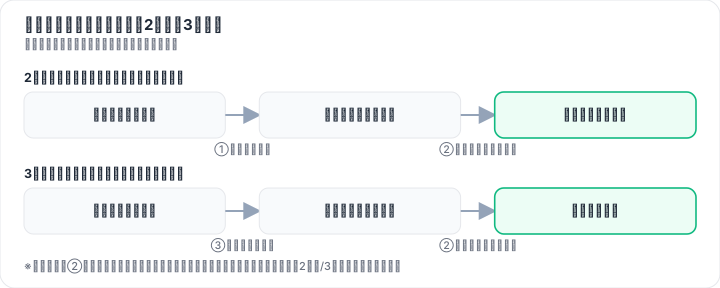
There are two main types of factoring: "Two-Party" and "Three-Party."
Two-Party Factoring allows you to raise funds without notifying your debtor (the client who owes you money), and in some cases, funds can be deposited as soon as the same day. Three-Party Factoring involves an assessment based on your debtor's creditworthiness, and fees tend to be kept low, starting from around 0.5%.
Top Management supports a wide range of entities, including corporations, sole proprietorships, freelancers, and newly established companies. Even sole proprietors operating under a trade name, like Mr. Tanaka, can apply as long as they have accounts receivable.
Chapter 2: What is Top Management? Track Record and Reliability of an Established Factoring Company
Through an online search, Mr. Tanaka discovered Top Management Co., Ltd. Established in 2009, this specialized factoring company boasts over 16 years of operation, with a cumulative track record of approximately 45,000 corporate clients and total purchase volumes exceeding ¥15 billion.

On multiple factoring comparison sites, this track record is highly rated for providing a strong "sense of security."
A key feature of the company is its extensive product lineup. In addition to standard two-party and three-party factoring, they offer a diverse range of solutions, including factoring based on quotes, orders, and purchase orders; "PayBridge," specialized for the advertising and IT industries; "Denfaku" for 2.5-party transactions; and "Zero Faku," which can be combined with government subsidies.
Furthermore, the company has strengthened trust in information security by obtaining ISO 27001 certification and has established a robust governance framework, notably appointing former House of Representatives member Jiro Ono as a management advisor.
Contracts are available on a non-recourse basis. This means that even if the account debtor goes bankrupt, the user has no obligation to buy back the receivables.
Various review sites feature comments such as:
The track record of over 45,000 purchases provides a great sense of security. (A certain factoring comparison site)
There is a sense of security in dealing with a visible, tangible presence. (Same site)
Impressed by this track record and corporate structure, Mr. Tanaka began to think, "I should hear more about them." The quickest way to check which products suit your company's situation is to visit the official website.
Chapter 3: Fee Structures Compared in a Table | Three-Party Factoring from 0.5%, Two-Party Factoring from 3.5%
Top Management's fees vary by product. Three-party factoring starts from 0.5%, while two-party factoring starts from 3.5%. Since three-party factoring involves credit assessment based on the account debtor, fees tend to be kept lower. On the other hand, two-party factoring does not require notification to the account debtor; while this results in higher fees, its main appeal is the speed of funding, available as soon as the same day.
| Item | Two-Party Factoring | Three-Party Factoring | Invoice/Order/Purchase Order Factoring |
|---|---|---|---|
| Fees | From 3.5% | From 0.5% | — |
| Notification to Account Debtor | None | Required | — |
| Funding Speed | As soon as same day | — | — |
| Primary Users | Sole proprietors, Corporations | Corporations, Sole proprietors | — |
Note: "—" indicates items where information published on official or comparison sites is limited. Fees are indicative only and conditions may vary depending on the creditworthiness of the account debtor, the amount of receivables, payment terms, and other factors. Therefore, it is important to first obtain a free quote or apply to understand the estimates specific to your business.
Chapter 4: From Application to Funding | Fully Online Process with Same-Day Deposits Possible
A key advantage of Top Management is its fully online process, which enables funding deposits as quickly as the same day. For busy executives like Mr. Tanaka, eliminating the need for in-person visits or mailing documents is a significant benefit.

The usage process is simple. First, enter the required details via the application form on the official website and submit your accounts receivable information. Afterwards, an assessment is conducted by a representative; once you agree to the contract terms, the purchase amount for the receivables is transferred to your account.
The application itself is free. By simply entering your accounts receivable information, you can get an estimate of the applicable fees and the expected funding date. Even if you have concerns about document preparation or the screening process, a support desk is available for consultations.
Chapter 5: Who Is It Really For? Options for Businesses Struggling with Cash Flow
Top management should consider this solution especially for sole proprietors who prefer not to notify their accounts receivable counterparts, or for small and medium-sized enterprises (SMEs) looking to quickly convert large outstanding invoices into cash.
There are two main reasons. First, two-party factoring does not require notification to the debtor, enabling fundraising without disrupting existing business relationships. Second, with funding available as soon as the same day, businesses can swiftly secure capital even when facing imminent payment deadlines.
Conversely, if accounts receivable have not yet been generated, or if minimizing fees is the top priority, it is advisable to compare this option with other financing methods. However, if you have outstanding invoices and prioritize speed along with maintaining smooth client relations, it is certainly worth checking the terms via a free quote and application.
Requesting a free quote and submitting an application is a low-risk first step that allows you to understand your company's eligibility and estimated funding timeline without incurring any costs. This encourages taking proactive action by simply giving it a try.
Please note that fees and funding timelines vary depending on the specific case. Always verify the latest conditions on the official website before signing any contract.
Methodology and Disclosure
Verification Method: This article was created based on public information verified as of 2026-08-26. Our editorial team has not actually contracted or used the services discussed. The explanations are based on public sources, including official pages, third-party reviews, and user feedback. Service details, fees, and campaigns are subject to change; please always verify official information before applying.
Publisher Information: Our editorial policy and evaluation criteria are outlined in our Editorial Policy, and our verification procedures are detailed in our Evaluation Methodology. Please report any errors to our contact desk.
Affiliate Disclosure: This article contains affiliate links, through which our site may earn a commission at no additional cost to you. These commissions do not influence our evaluations.
Frequently Asked Questions
What are Top Management's fees?
Three-party factoring starts at 0.5%, and two-party starts at 3.5% (conditions apply). Fees vary based on the creditworthiness of the account debtor, the amount of receivables, and payment terms. For an accurate quote, you can apply for free.
How quickly can I receive funds?
With two-party factoring, same-day funding is available. If the review and contract process goes smoothly, you may receive funds the same day. However, depending on the case, it may take until the next business day or later.
Can sole proprietors use the service?
Yes, they can. Top Management supports corporations, sole proprietors, freelancers, and newly established companies. As long as you have accounts receivable, sole proprietors operating under a business name can apply.
What are the main reasons for application rejection?
The main reasons for rejection include low creditworthiness of the account debtor or issues with the receivables themselves. Additionally, incomplete documentation can delay the review or lead to rejection. Check the requirements in advance.
What is the difference between two-party and three-party factoring?
Two-party factoring allows you to raise funds without notifying the account debtor and offers same-day funding, but fees are higher (from 3.5%). Three-party factoring is based on the credit of the account debtor, with lower fees (from 0.5%), but requires notification to the account debtor.
Is an online interview (Zoom) mandatory?
The article does not specify whether an online interview is mandatory. However, it states that applications can be completed online, and it is likely that online consultations are available if needed. Check the official website for details.
What is the minimum purchase amount?
The article does not specify a minimum purchase amount. However, it suggests that as long as you have accounts receivable, you can use the service, so even small amounts may be accommodated. For exact figures, check the official website or contact them.
What documents are required for application?
The article does not specify the exact documents required, but it mentions that you enter information about your accounts receivable in the application form. Typically, identification documents and contracts related to the receivables are needed. Check the official website for details.
Sources
This article is based on publicly available information as of 2026-08-26.
Related articles
IwaiCosmo Securities Review 2026: Honest Look at Fees and IPO Lottery Odds, Plus Zero-Fee NISA
Get the latest 2026 review of IwaiCosmo Securities. We take an honest look at their strong IPO underwriting track record, zero trading fees for NISA accounts, overall fee structure, and customer support. Compare with major online brokerages.
Fujitomi Securities FITS Review 2026: Fees, Features, and Why It's Ideal for Commodity Futures Beginners
A comprehensive review of Fujitomi Securities' online commodity futures trading platform, FITS. Discover industry-low fees (from ¥412 per side for standard contracts, conditions apply), beginner-friendly tools and support, and the loss cut system. Updated for 2026.
What is the reputation of moomoo Securities? Thorough comparison of fees, features, and reviews [2026 Latest]
Thorough explanation of moomoo Securities' reputation based on fees, features, and reviews. US stock fee 0.132% (with conditions), Japanese stock free, exchange fee 0 yen (with conditions), 24-hour trading, AI analysis tools, etc. Compare the latest information for 2026. Also note points such as not supporting Tsumitate NISA.