
| XM Trading 4 | Exness 1 | |
|---|---|---|
| Overall rating | 4.8 / 5 | 4.8 / 5 |
| Min. deposit | $5 | $10 |
| Max leverage | 1:1000(Zeroは1:500) | 1:Unlimited |
| Spread from | 0.0 pips | 0.0 pips |
| Regulatory licenses | 4 | 3 |
| Trading platforms | 3 | 2 |
| Bonus | Yes | No |
We compared over 27,000 reviews and cross-checked them against the official terms and conditions. Here's the verdict: If you prioritize cost and execution speed, choose Exness; if you want to grow your account with bonuses and educational content, choose XM. However, whichever you pick, unless you run a "withdrawal test" immediately after your first deposit, you have no right to feel secure leaving your funds with them. XM's withdrawal delay reports are too numerous to ignore, and Exness's offshore entity assignment carries the risk of missing compensation coverage. Reflecting the latest data as of August 2026, we've re-verified both companies' actual conditions based on their terms. Let's get to the conclusion first: If you're scalping or running EAs and trading over 5 lots per month, Exness's Raw/Zero account is the only choice. If you're starting small and want to learn while leveraging bonuses, XM's Ultra Low account is suitable. However, for either account, always check which entity you're assigned to at account opening. Get this wrong, and your level of protection drops dramatically.
1. XM vs Exness: Basic Comparison – Regulatory Status, Minimum Deposit, Account Types
Before comparing costs or withdrawal conditions, it is essential to clearly understand the requirements each broker sets for starting trading, their regulatory bodies, and the available account types.
XM's minimum deposit is just $5 (for all accounts except stocks), making it one of the lowest in the industry. In contrast, Exness starts from $10. This small difference is significant. For example, if you only have $50 in funds, with XM you can immediately open a Standard, Ultra Low, XM Zero, or Micro account, while with Exness you need at least $10 to open a Standard or Standard Cent account.
Both brokers hold licenses from multiple regulatory authorities, but the actual protection you receive depends on the legal entity you are assigned to. XM is licensed by CySEC, ASIC, FSC (Belize), FSCA (South Africa), FSC (Mauritius), FSA‑S (Seychelles), CMA (UAE), and DFSA (Dubai). Exness is regulated by FCA, CySEC, and FSA Seychelles.
| Item | XM | Exness |
|---|---|---|
| Minimum Deposit | $5 | $10 |
| Number of Account Types | 5 (Standard, Ultra Low, XM Zero, Micro, KIWAMI) | 6 (Standard, Standard Cent, Low Spread, Zero, Pro, Raw) |
| Key Regulatory Bodies | CySEC, ASIC, FSC, FSCA, FSA‑S, CMA, DFSA | FCA, CySEC, FSA Seychelles |
| Negative Balance Protection | Fully supported across all entities | Only for FCA/CySEC entities |
| Recommended Traders | Beginners, bonus-focused traders, those seeking educational content | Cost-conscious active traders, scalpers |
Key Points: XM allows you to start trading from $5 and offers broad negative balance protection across all entities, providing a strong safety net for small accounts. Exness starts from $10 but offers professional account types (Raw, Zero) preferred by active traders.
Please check each broker's official website for the latest regulatory status and account type details.
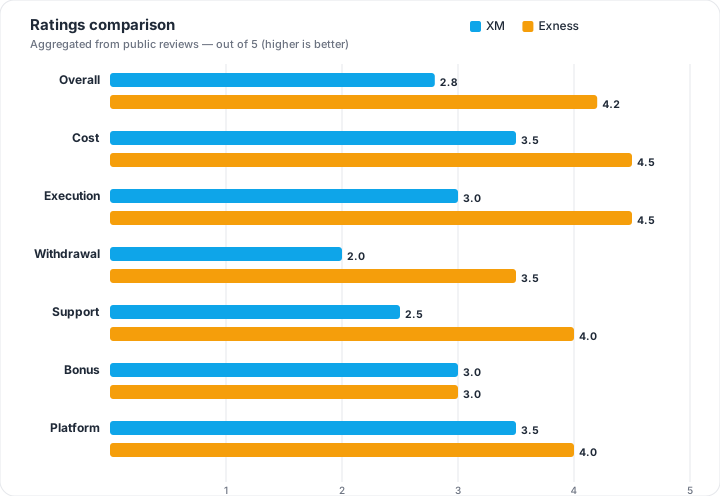
Figure: Overall and category-specific evaluation comparison (aggregated from public reviews, out of 5 points)
2. Real Cost Showdown: Spreads, Commissions, and All Trading Costs
Cost is the most critical factor for any trader executing more than a few lots per month. Here, we compare the published spreads for a standard lot (100,000 units) of the major currency pair EUR/USD. The value of 1 pip is set at $10.
| Broker / Account Type | Spread Cost (Pips → USD) | Commission (1 Round Lot) | Total Cost |
|---|---|---|---|
| XM Standard | 1.6 pips → $16 | $0 | $16 |
| XM Ultra Low | 0.6 pips → $6 | $0 | $6 |
| XM Zero | 0.1 pips → $1 | $7 (round trip) | $8 |
| XM KIWAMI | 0 pips → $0 | $0 | $0 (spread only. KIWAMI availability varies) |
| Exness Standard | Approximately 0.5–1.0 pips lower than typical levels → ~$5 (estimated) | $0 | ~$5 |
| Exness Zero / Low Spread | 0.0 pips → $0 | $3.50 one way → $7 round trip | $7 |
Prerequisites: 1 pip of EUR/USD = $10, 1 standard lot, spreads are published standard values. Actual execution spreads and account types may vary.
A clear trend emerges from this table. The cost for an Exness Zero/Low Spread account is approximately $7 per lot, roughly half of XM Standard's $16, and even lower than the commission-free XM Ultra Low (spread only at $6). For scalpers and high-frequency traders, Exness's near-zero spreads and low commissions offer a clear advantage.
However, XM's KIWAMI account (0 pip spread, $0 commission) may outperform Exness in raw spread cost, but it is not available to all clients. For trading less than 3–5 lots per month, the difference between $6 (XM Ultra Low) and $7 (Exness Low Spread) is negligible. In that case, XM's bonus program could be the deciding factor.
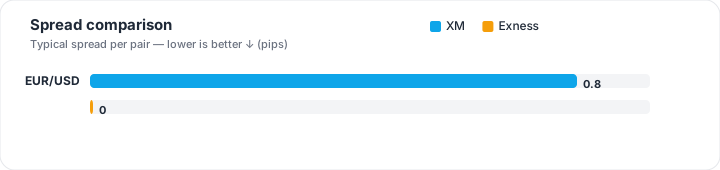
Figure: Spread comparison for major currency pairs (actual data; lower is better)
If you trade more than 5 lots per month, consider low-cost Exness. However, if bonuses are important to you, read on. Combining XM's Ultra Low account with the welcome bonus (current bonus terms) could offset the spread difference.
3. Bonuses and Promotions: What XM Offers and Why Exness Does Not
Bonuses are a key differentiator for XM. The broker offers a No Deposit Bonus (current bonus terms) and a Deposit Bonus (Up to $10,500 deposit bonus) for new accounts, with the total available amount collectively referred to as current bonus terms. These are not free money; they come with trading volume requirements. Typically, you must trade 50 to 100 times the bonus amount before you can withdraw any profits.
In contrast, Exness does not offer specific bonuses. The company's strategy is to keep spreads low and avoid conditional promotions. Evidence shows that "no specific bonuses are listed in search results" – this is a deliberate policy.
Why it matters: With XM's Up to $10,500 deposit bonus, a $200 deposit gives you current bonus terms in additional trading funds. For beginners with small accounts, that extra margin can help you survive a losing streak. However, you must meet the trading volume to activate the bonus. Exness does not provide additional funds, but it also imposes no trading turnover obligations.
Honest note: "Bonuses are not gifts. To withdraw profits, you must achieve the required trading volume (usually 50 to 100 times the bonus amount). Always read the terms and conditions." If you are a disciplined trader who can meet the volume requirements, XM's bonuses are valuable. If you prefer to withdraw profits immediately, Exness's bonus-free model is cleaner.
– Claim XM's welcome bonus (current bonus terms) now, boost your balance, and start trading. Terms and conditions apply, so be sure to read the details.
4. Withdrawal Safety and Speed: Real User Experiences with XM and Exness
Withdrawal reliability is the biggest concern for most retail traders. Here, we look at the evidence without exaggeration.
XM Withdrawal Experience: The broker states that transfers to local Indian bank accounts are processed within 2 business days. However, many user reports paint a harsher reality. Trustpilot reviews (as of 2026) include the following:
"I deposited ₹23,000 via UPI on April 15, 2026 at 1:20 PM (UTR ending 80109). The transaction was successful, but the amount was not reflected in my XM wallet."
This negative trend is also reported by Forextradingjournals.com: "Hundreds of traders report deposits disappearing mid-transfer or withdrawals stuck in an endless rejection loop."
Exness Withdrawal Experience: On Trustpilot, Exness has an overwhelmingly positive rating of 4.7/5 based on 26,918 reviews. A typical positive comment: "The vast majority of reviewers had a great experience with this company. Customers consistently praise the platform for being user-friendly for both beginners and experienced traders. Many highlight excellent service and fast execution speeds."
However, Investigations.org points to a "persistent pattern of withdrawal complaints" and rates Exness as high-risk at 66/100 due to offshore routing. This means that while positive sentiment is strong, risks still exist.
Comparison Table:
| Item | XM | Exness |
|---|---|---|
| Standard Withdrawal Time | 2 business days (stated) | Not specified; most users report fast |
| User Sentiment (Positive) | 30% | 80% |
| Common Complaints | Disappearing deposits, endless rejection loops | Some withdrawal issues, offshore routing |
| Support Channels | Email, phone, local bank integration | 24/7 support, regional payment routes |
Recommendation: First, test with a small deposit ($20–$50) and try to withdraw as soon as possible. If the process goes smoothly, you can increase your balance. Never deposit more than you can afford to lose with any broker.
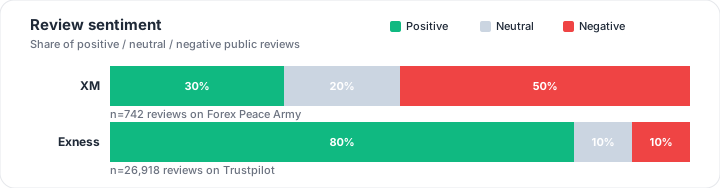
Figure: Breakdown of user sentiment (Positive/Neutral/Negative)
*To protect your funds, open an account with a small deposit and test the withdrawal process.
– XM supports local INR deposits and withdrawals in some regions, which can speed up the process.*
5. How to Open an Account with XM and Exness: A Step-by-Step Guide
Opening an account with either broker is straightforward. Below is the general process (exact steps may vary by region).
XM
- Register – Enter your personal information on the XM website.
- Verify Identity – Upload a government-issued ID and proof of address. Verification typically takes 1–24 hours.
- Choose Account Type – Select from Standard, Ultra Low, XM Zero, Micro, or KIWAMI. Refer to the cost comparison table in Chapter 2 to decide.
- Deposit Funds – Deposit from as little as $5 using credit/debit cards, bank transfers, or local payment methods (e.g., UPI in India).
- Start Trading – Download MT4/MT5 or use the web platform.
Exness
- Register – Sign up on the Exness website.
- Verify Identity – A similar process, usually completed quickly.
- Choose Account Type – Select from Standard, Standard Cent, Low Spread, Zero, Pro, or Raw.
- Deposit Funds – Deposit from as little as $10 using UPI, M-Pesa, GCash, credit cards, or other local methods.
- Start Trading – Enjoy leverage of up to 2000:1.
Pro Tip: Both brokers offer free demo accounts. Use them for at least a week to test spreads, execution, and platform stability without risking real funds.
– Ready to start trading? Open an XM account with just $5 in minutes. Click the link below to begin.
6. Account Type Comparison: Which Broker Suits Your Trading Style?
Refer to the recommendations below based on your scenario to choose the optimal account.
Beginners (From $50)
- XM Micro Account (Minimum deposit $5, no commission, supports micro lots) – Low entry barrier.
- Exness Standard Cent Account (Trading from 0.1 lots, minimum deposit $10) – Ideal for small positions.
Scalpers / Short-Term Traders
- Exness Zero Account or Raw Account – Spreads from 0.0 pips on EUR/USD, commission of $3.50 per side. Effective cost per lot is $7, making it the lowest cost for high-frequency trading (based on publicly available information as of June 2026).
- XM Zero Account – Spreads from 0.1 pips plus a round-turn commission of $7 (total $8) – Slightly more expensive but still competitive.
Bonus-Focused Traders
- XM Ultra Low Account – Spread cost of $6 per lot (no commission), plus eligible for Up to $10,500 deposit bonus. Enjoy both bonuses and tight spreads.
Algorithmic / EA Traders (Large Capital)
- Exness Raw Account – Free VPS for deposits of $500 or more, ultra-low commissions.
- XM KIWAMI Account – 0 pip spreads, $0 commission – However, availability may be limited to certain regions.
| Account Type | Minimum Deposit | Spread (EUR/USD) | Commission | Best For |
|---|---|---|---|---|
| XM Standard | $5 | 1.6 pips | $0 | Small budget, casual trading |
| XM Ultra Low | $5 | 0.6 pips | $0 | Bonus-focused, low cost |
| XM Zero | $5 | 0.1 pips | $7 round-turn | Active traders seeking low spreads |
| XM KIWAMI | Variable | 0 pips | $0 | Scalpers (where available) |
| Exness Standard | $10 | Approximately 0.5–1.0 pips lower than typical levels | $0 | Beginners, lower cost than XM Standard |
| Exness Zero/Raw | $10 | 0.0 pips | $3.50 per side ($7 round-turn) | Scalpers, EAs, high-frequency trading |
– Open an XM Ultra Low Account to enjoy tight spreads and a welcome bonus (Up to $10,500 deposit bonus).
7. Hidden Risks: Leverage, Negative Balance Protection, and Offshore Regulation
Both brokers have risks that should be understood before depositing.
Negative Balance Protection: XM offers full protection across all entities. This means that even in extreme market volatility, you will not incur losses exceeding your account balance. Exness only provides this for FCA/CySEC entities. If your account is assigned to the Seychelles entity, you may not receive the same protection.
Leverage: Exness allows up to 2000:1, which is attractive for small accounts but amplifies losses. XM's maximum leverage is not explicitly stated in the evidence, but under CySEC rules, it is generally lower for retail clients. If you keep risk per trade small, high leverage is not a major differentiator.
Offshore Routing: Exness has been criticized for "marketing Tier1 FCA/CySEC licenses primarily for professional clients while directing retail clients to offshore jurisdictions (Seychelles, Curaçao)." XM also assigns many clients to FSC Belize or FSA Seychelles entities, which offer weaker consumer protection than CySEC or ASIC. Check which entity you are assigned to during registration.
Common Objections:
- "Is XM a scam?" – It is not a classic scam. It is licensed by multiple regulators. However, hundreds of traders report lost deposits or delayed withdrawals, which appears to be a settlement infrastructure issue rather than intentional fraud.
- "Is Exness a scam?" – Exness processes over $4 trillion in monthly trading volume and is a legitimate major broker. However, offshore routing and persistent withdrawal complaints increase risk. A report from Investigations.org classifies it as high risk with a risk score of 66/100.
Practical Advice: If your country of residence is a restricted jurisdiction (e.g., USA, Canada), neither broker will accept you. If you are in an eligible jurisdiction, aim for a CySEC or ASIC entity. XM's full negative balance protection is a genuine advantage for cautious traders.
– Before opening an account, check which regulatory entity you will be assigned to. XM clearly discloses entity information during registration.
8. Final Assessment: Which Broker Should You Choose in 2026?
After examining costs, bonuses, withdrawal reports, and regulatory structures, here is our honest conclusion.
Choose XM if:
- You prioritize the lowest minimum deposit ($5) and want to grow a small account using the welcome bonus (current bonus terms).
- You value educational content – XM offers webinars 7 days a week in 23 languages.
- You are willing to accept potential withdrawal stress and test with a small amount first.
Choose Exness if:
- Your top priority is the lowest overall trading costs (especially for scalping, EAs, or high-frequency trading).
- You prefer a clean model with no bonuses and can accept the risks of offshore routing.
- You value fast execution and 24/7 support.
Final word: Neither broker is perfect, but if you choose your account carefully and keep your initial deposit modest, both are practical options. Start small, test withdrawals, and never risk more than you can afford to lose.
– Start with XM now to receive current bonus terms and access educational resources. Cost-focused traders may also consider Exness.
Risk Warning: Forex trading carries significant risk and you may lose your entire investment. Past performance does not guarantee future results. Only trade with funds you can afford to lose and seek independent financial advice if needed.
Methodology and Disclosures
Methodology: This comparison aggregates publicly available data from brokers' official pages, regulatory registers, and independent review aggregation sites, verified as of June 14, 2026. The editorial team has not conducted actual trades with the brokers covered in this review. For details, please refer to the Methodology.
Affiliate Disclosure: Some links included in this article are affiliate links, which may result in us receiving a commission at no additional cost to you. The presence or absence of compensation does not affect our rankings or analysis. For details, please see our Editorial Policy.
FAQ
Which broker has lower spreads, XM or Exness?
Exness's Raw/Zero account has lower spreads per lot (e.g., EUR/USD 0.0 pips + $3.50 commission per side), while XM's KIWAMI account offers 0 pips spread with no commission, but other XM accounts have wider spreads. Overall, Exness is more cost-effective for active traders.
Is XM's bonus worth the conditions?
XM offers current bonus terms and deposit bonuses up to current bonus terms, but conditions vary by region and require high trading volume (e.g., lot count). Bonuses are only valuable if you plan to trade enough to meet the conditions; otherwise, they may cause withdrawal restrictions.
Is withdrawing from Exness safe?
Exness has ongoing complaints on Trustpilot about withdrawal delays, but many users report smooth withdrawals. To ensure safety, start with a small deposit and test withdrawals before depositing large funds. Choose regulated entities (FCA/CySEC) for added protection.
Does Exness offer negative balance protection?
Exness provides negative balance protection only for FCA and CySEC-regulated entities. Offshore entities (e.g., FSA Seychelles) may not offer this protection. XM provides full negative balance protection across all entities, making it safer for small accounts.
Which broker is better for scalping?
Exness explicitly allows scalping on all accounts and offers ultra-low spreads on Raw/Zero accounts, making it ideal for scalpers. XM also permits scalping, but spreads are wider on some accounts. Exness wins in terms of low cost and fast execution.
Can I use a demo account with XM or Exness?
Yes, both brokers offer demo accounts. XM's demo account is particularly rich in educational resources, while Exness provides virtual funds for strategy testing. Both demo accounts are free and have no time limits.
What is the minimum deposit for each broker?
XM requires a minimum deposit of $5 for all accounts except stocks. Exness requires $10 for Standard and Standard Cent accounts. Professional accounts (Zero, Raw) may require higher deposits; please check each account's conditions.
Which broker accepts clients from my country?
Both brokers have country-specific restrictions. XM does not accept US residents, and Exness is restricted in several countries including the US, Canada, and Australia. Before signing up, check each broker's website for your country's eligibility and local regulations.
Sources & Verification
This article was fact-checked on 2026-06-14. Key claims:
- "XM Reviews | Read Customer Service Reviews of xm.com" — verified via https://www.trustpilot.com/review/xm.com on 2026-06-14
- "XM review: Is it a legit or scam forex broker?" — verified via https://www.forexpeacearmy.com/forex-reviews/7214/xm-review on 2026-06-14
- "XM Review 2026: An Honest Take And The Catch" — verified via https://kenmacro.com/xm-review-2026-honest-take/ on 2026-06-14
- "XM Group Review (2026): Costs, Regulation & Platforms | ForexCracked" — verified via https://www.forexcracked.com/forex-brokers/xm/ on 2026-06-14
- "Is the XM Scam Real? Trader's Investigation" — verified via
https://forextradingjournals.com/xm-scam/on 2026-06-14 - "XM Review 2026: Low-Deposit Multi-Entity Retail Broker" — verified via https://www.fxroboteasy.com/broker-reviews/xm on 2026-06-14
- "XMTrading: Trade Forex with transparent fees & costs" — verified via https://www.xmtrading.com/trading-fees on 2026-06-14
- "XM - Cost and Charges" — verified via https://cloud.xm-cdn.com/static/pdf/System-PDFs/XM-Cost-and-Charges.pdf?v=c7ba5e1c63676f98ab4275be7ff639b8 on 2026-06-14
- "XM Spread Table: Daily Costs for All Instruments & Accounts | Forex FanClub" — verified via https://fxfan.club/en/xm/trading/spread/ on 2026-06-14
- "June 2026 XM Report: Spread, Swap Cost, Funding Fees and other Commissions | XM – Hercules.Finance" — verified via https://hercules-finance.com/xm-report-spread-swap-cost-funding-f on 2026-06-14
- "Exness Reviews | Read Customer Service Reviews of exness.com" — verified via https://www.trustpilot.com/review/exness.com on 2026-06-14
- "Exness Review: Offshore Routing, Withdrawal Complaints & Regulatory Analysis" — verified via https://www.investigations.org/report/exness-review-and-osint-report on 2026-06-14
Hero image: AI-generated by Northmark.
Related articles
Best Forex Brokers August 2026 — Compared by Safety, Spreads, Bonuses & Withdrawals
A practical 2026 guide to choosing a forex broker: how we weigh regulation, real trading costs, bonuses, withdrawals and platforms — plus where XM, Exness and IC Markets fit and who each suits.
Measured broker spreads 2026-W37 — logged hourly from our own MT5 accounts
Not a copy of published spread tables: 196,636 hourly bid/ask samples taken on our own accounts (HF Markets (SV) Ltd. / OANDA Corporation / XM) over 2026-08-30 → 2026-09-06, broken down by pair and by hour of day.
Measured broker spreads 2026-W36 — logged hourly from our own MT5 accounts
Not a copy of published spread tables: 186,878 hourly bid/ask samples taken on our own accounts (HF Markets (SV) Ltd. / OANDA Corporation / XM) over 2026-08-23 → 2026-08-30, broken down by pair and by hour of day.